Background
Summary
While working on the cart and checkout experience, I was approached by the logistics and fulfilment department with proposals for new carriers and delivery options to present to our users. In a short time, I had to evaluate the business proposals, understand our customers’ needs and pain points, and develop a viable solution.
Once successfully identified what our customers needed and wanted in terms of delivery, the solution was pitched to stakeholder. The execution and launch of multiple carrier options alongside "locker delivery" increased order and delivery in rural areas by 6%, 11% reduction of last-mile delivery cost and an increase in the net promoter score of 0.4.

Flaconi homepage
Role
As the principal designer for the project, I was responsible for a variety of UX related tasks, including conducting competitor analysis, moderating workshops, designing mockups, prototyping, preparing user tests (both moderated and unmoderated), and participating in user test observation and moderation.
Challenge
At the start of the initiative, we were collaborating with Hermes as our delivery partner, but the logistics and fulfillment departments aimed to expand our offerings by integrating DHL and exploring additional options such as express delivery and carbon compensation. Furthermore, there was an idea to collaborate with two logistics startups: Instabox and Urbify. Instabox proposed installing lockers in urban areas for parcel collection, while Urbify offered express, sustainable delivery services.
From a user perspective, our task was to verify whether these proposals aligned with customers’ needs. Time was also a critical factor, as we had only a couple of months before a new, updated contract was to be signed with our current delivery partner and potentially with new ones as well.
Process
Ideation
The project kicked off by looking at what types of delivery options and services our competitors and other e-commerces were providing to their users. Additionally, we researched what type of options our delivery partners were able to offer us.
As the next step, I organized a workshop with the team to define goals and address our questions using the "How Might We" framework to explore possibilities and the result was the following scenarios:
Anything but Hermes: Explore how different factors like price and carrier resonate with users by presenting options such as free Hermes delivery, DHL delivery at a standard cost, and express delivery at an additional charge.
Sustainability: Assess the importance of sustainability to customers and determine how much they are willing to pay for environmentally friendly options.
Parcel stations: Highlight the sustainability benefits of parcel stations compared to home delivery while introducing Instabox as the most environmentally friendly option available.
Standard or express delivery?: Evaluate the appeal of express delivery to users. Does the price deter customers from choosing this option?


Analysis board for Instabox and Urbify
Design & Validation
After multiple rounds of prototyping, the design requirements were set to test our scenarios with users.


Delivery options on mobile
To validate the design decisions, I conducted rapid user interviews and 15-minute usability tests to gain deeper insights into customers’ habits and evaluate the latest iteration of the mockups. The key themes explored included users’ favorite carriers (if any) and what makes a carrier trustworthy, the importance of sustainability, the use of parcel stations, and the perceived value of express delivery. The results were the following:
Cost Over Speed: Users prioritize low-cost standard delivery. They reject premium fees for express or sustainability, expecting the company to absorb eco-costs and communicate green practices transparently.
Carrier Trust: Customers trust the shop to choose the carrier (DHL is favored; Hermes is improving) but demand clear visibility on who is delivering.
Home Delivery First: Deliveries to front doors, neighbors, or designated drop-off spots are heavily preferred over parcel lockers. Driving locker adoption requires better communication of their benefits.
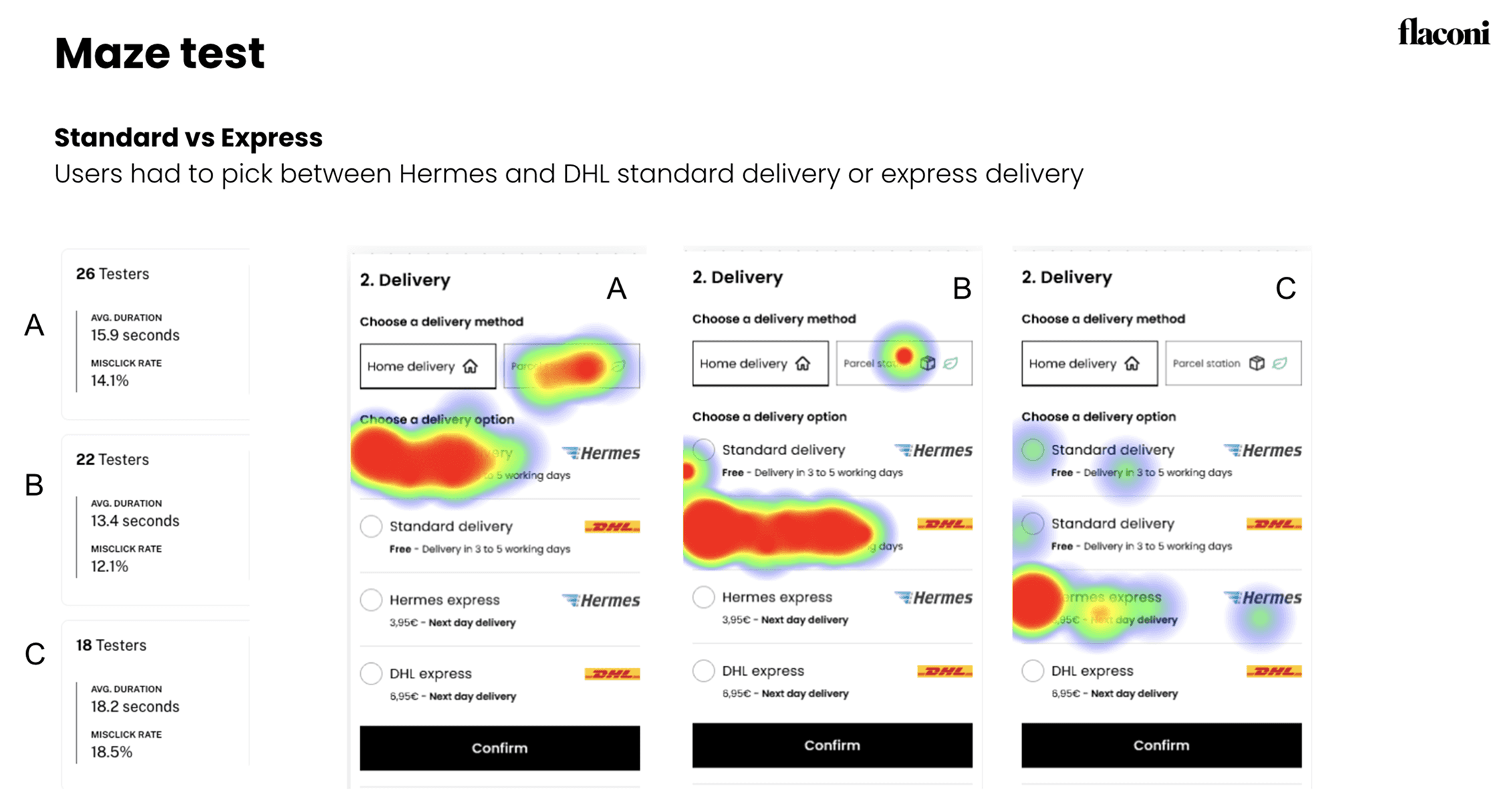
Heat map of a task during user testing
Outcome
The solution aligning business goals with customer needs to stakeholders was the following:
Keep Hermes & Add DHL: Use standard delivery for both to improve logistics, particularly in rural and remote areas.
Integrate Instabox: Offer this parcel station option to reduce delivery costs and highlight sustainability.
Exclude Urbify: Do not collaborate with them, as users showed little interest in paying extra for express delivery.
Test Carbon Compensation: Allow users to opt into a low-cost carbon offset for home delivery while improving sustainability messaging.
Following implementation, key metrics showed:
6% increase in rural orders and deliveries.
11% reduction in last-mile delivery costs.
0.4 increase in Net Promoter Score (NPS).